March 9 - 13

(pictures of animals made in art last week)


On Monday we went on our field trip to the Museum of the Earth with our partner class from Northeast Elementary School.  Before the trip we role played what it would be like to ride the bus next to our buddy and how to ask questions that require more than a "yes" or "no" answer to help keep the conversation going.  We also had a goal to find at least three things that we both liked before we arrived at the museum.  


When we got there we split into two groups and took turns completing a scavenger hunt (look for a copy of it coming home with the Friday hand-outs) and a presentation by Samantha Sands  in which students got to handle many fossils and learn about different kinds of dinosaurs.  We got to ride the bus to Northeast so our students could see what their school looked like, and then at the end of the day the bus dropped us off first so the other students could see what Belle Sherman looked like.  Thank you to all the family members who took time out of their day to join us there.


Scroll down to see pictures and hear student reflections on the experience.  Next week we will try to have a webchat with Samantha to ask some follow-up dinosaur questions and she will come to our school to deliver a copy of Digging Up Dinosaurs by Aliki for every student!
This week in math we have been looking at the second hand on the clock and seeing how many times we can do certain things in 15 seconds.  The students quickly figured out that 15 seconds occur every time the second hand goes past any 3 numbers on the clock.  They also noted that there are four groups of 15 seconds in a minute (15 + 15 + 15 + 15 = 60) and four groups of 15 minutes in an hour.
The trickiest part of the math this week was when we gathered data and then had to find the range (the difference between the highest and lowest numbers) and the middle point between those numbers.  We used a 100 chart and looked at shortcuts to find the range, like each row = a group of 10.  Friday's homework includes practice for this concept.


In reading we practiced making a prediction, checking to see if it was correct (or partially correct), and then finding the evidence that the prediction was based on.  Students did a great job using this strategy to improve their comprehension, and using a sticky note and pencil as tools to record their thinking.  Next week we will practice looking at word endings to improve our accuracy (works vs. worked vs. working) and illustrating/writing the main parts of the story to improve our comprehension.  We also made bookmarks this week to help us remember which book we were reading last and what page we were on.  I am trying to have students pick out a few books to read to someone outside of school at least once each week.  Thanks for getting the book envelopes back to school in a timely manner so we can send new books home!  Please use the notes page to share any feedback about the level of difficulty of the books and the attitude/effort/level of success you see from your child.


We are also working on keeping sharing a time for storytelling and not merely "show and tell."  PLEASE remind your child that he/she can bring in an artifact, souvenir, picture or other prop that supports the story they want to tell, but that this is not a time to just show a toy and say "I think this is cool."  We are trying to develop good listening and speaking skills.  We are also building our classroom community by helping students get to know each other better and feel safe opening up to each other.  I do not want anyone to feel like they have nothing to share if they don't have an expensive/new toy, or for it to deteriorate into oneupsmanship.  


For ideas on how you can help prepare your student for a successful sharing/storytelling experience, please see this online article from the Responsive Classroom program - the workshop series I am attending one day a week for the next several weeks.  Thank you for your support.  Also please continue the conversations we have been having about sitting next to different people when we sit in a circle for morning meeting and snack/sharing.  I will be assigning students to new seats at the tables over the weekend, too. 


Finally, thank you for all of the birthday cards and treats this week!  It was really fun to celebrate with the class on Thursday.  Enjoy these pictures from recent choice time and the birthday snack:
       

March 2 - 6

It has been a busy week!  I've really enjoyed having conferences with each of you and I appreciate everyone making accommodations for the two half days.  Please remember that I'm happy to meet with you again before the end of the year report cards come out if you have any new questions or concerns.

We got a "second grade style" desk that will stay in the room for the rest of the year.  Everyone will get a chance to do some work there to see what it will feel like next year, and it will serve as a quiet place to work for anyone who is too distracted at their group table.  I will also move everyone's seating assignments on the carpet and at the tables in a few weeks.


This week in math we introduced quarters and will continue to study them next week.  Students will be working on comparing two groups of coins and making a sum of money with different combinations of coins. In the Everyday Math curriculum the coins are often represented by the first letter of the coin name in a circle.  To reinforce the coin values, we have been drawing a dot for each group of five cents on these coin symbols; so a nickel gets one dot, a dime gets two dots, and a quarter gets 5 dots:
  
This strategy can help students who struggle to count a group of these coin symbols, especially when they are not in order (pennies do not get any dots and are counted last in the group, which involves switching from counting by 5s to 1s). You can try drawing these dots this when you help your child with his/her math homework and any extra challenge problems you give him/her! 
In reading this week we worked on predicting as a strategy to improve our reading comprehension.  We started using a sticky note to mark where in the book we made a prediction (cover, beginning or middle of the story...) and then checked how accurate our prediction was.  Next we will begin writing/drawing/recording our predictions and writing/drawing/recording what actually happened in the story, and then we will write/draw/record our predictions and our evidence on which our predictions are based. 

In reading we also practiced looking for letters that have more than 1 sound and trying both sounds  to improve our accuracy when we have to sound out unknown words.  We have displays in the room for Cc (/k/ like candy or /s/ like cereal), Gg (/g/ like gorilla or /j/ like giraffe) and the long/short vowel sounds. 
We continue to look for spelling patterns that can be a signal for which vowel sound the vowel will make (like silent e: rid vs. ride, and rhymes: day, bay, ray).


We had a good discussion about the importance of including everyone and making new friends.  We discussed what it can look like when people are left out on the playground and in the classroom, and that's not OK to tell someone that they can't play with you or to have a club that certain people cannot join.  We talked about how people felt when they were excluded, how to get help when it happens, and what we can do to prevent those situations from happening so no one feels sad. 

We came up with several ideas which we plan to develop into some short skits that we hope to perform for the Kindergarten classes to help teach them how to be a good friend to everyone.  In addition to supporting students working/playing/sitting with new people in the classroom, I'm also going to encourage students to invite friends from the other first grade and Kindergarten classes to come eat lunch and have choice with us in our room (and vice versa) to help develop new friendships.  Please discuss these important lessons with your child and ask them who they are trying to befriend.

On Monday we will meet our buddies from Northeast Elementary School when we go to the Museum of the Earth!  We will share a bus with our buddies and will work on some conversation skills to help make the bus ride fun for everyone.  We will complete a scavenger hunt, a hands-on fossil activity, and eat lunch at the museum with our buddies.  I will email those of you who volunteered to chaperone with more details.  After the field trip we will do several activities on dinosaurs and other extinct animals, then we will study endangered animals.


I want to let you know that you will see some substitutes once a week for the next six weeks as I will be  attending all-day teacher workshops on the Responsive Classroom approach to teaching.  This program aims to create a strong and safe school community that emphasizes social, emotional, and academic growth.  I have already studied this program's literature and am eager to learn more.  While I don't like to be out of the classroom, I really believe in the value and importance of this program and I appreciate that our district does, too (it's required of all teachers new to ICSD).

Next week's sight words will be: ask, many, new, once, wrong.

February 23 - 27

This week we welcomed Ryan back to the classroom!  He has done a great job learning the routines and reconnecting with everyone.  I've been really proud of how the students have been eager to help him and include him.

We started studying "fact families" in math, which involves making 2 addition equations and 2 subtraction equations using a set of 3 numbers (e.g. 5+3=8, 3+5=8, 8-3=5, 8-5=3).  We also introduced name collection boxes, which are various ways to make or say a number (e.g. 12 = 1 dozen, twelve, 6+6, 14-2, etc.), and the addition/subtraction table which can help students see patterns in addition and subtraction.

We also learned two new reading strategies and practiced using each:
1. paying attention to ?, !, words in bold, italics, underline or otherwise different to read more fluently and with expression, not like a robot.
2. picking a word from a book to remember and try to use in conversation/writing that same day to expand your vocabulary.

In writing we addressed the first grade goal of using the words like "First, Next, Then, Last" to organize our sentences when we wrote instructions for how to do something.  I will have copies of your child's writing available for you to take home at his/her conference next week.

Please remember that students will be dismissed at 11:00 on Thursday and Friday next week.  

We would really appreciate additional tissues and glue sticks for the classroom.  
Thanks so much for your ongoing generosity!

Next week's sight words will be: door, just, last, more, pick
Enjoy these pictures from the past two weeks:


February 9-13

Happy Valentine's Day!  I hope you enjoy all the beautiful crafts your child brought home this week.   Many of the crafts will be available during choice time for the next few weeks for anyone who missed that day or wants to make more.  We will make Borax crystals in different colors later in the year.  Directions for making Borax crystals yourself are available online.    Thanks to Mary Jo for providing many of the supplies and to all the volunteers who helped out! I will post pictures of the festivities here soon. 


Please remember there is no school next week (February 16-20).  When we return we will begin learning about dinosaurs in preparation for our field trip to the Museum of the Earth on March 9.  In addition to learning science, specifically paleontology, one of the objectives of the field trip is to develop friendships between the schools as the students will eventually end up at the same middle school.  We will practice some conversation skills to help facilitate social interaction between the students, especially on the bus ride when students will be sitting with their buddies.


This week in writing we responded to letters from our field trip buddies at Northeast Elementary School!  We also worked on describing a specific event in great detail, by explaining each step we took to make a wheel and axle design in science using words like First, Next, Then and Last to organize our writing.  That piece of writing will be on display in the hall outside the classroom and you can see more examples of your child's writing during conferences in the first week of March.  If you have not already scheduled a conference time, you can do so below or I will contact you after the break.

This week in math we reviewed drawing a picture for a word problem, using "doubles" addition facts to solve similar problems (e.g. if 5+5=10 then 5+6=11), and using function machines more.  We also used tangrams and played some money games with $1, $5, $10, $50 and $100.  Please continue to help your child memorize the "doubles" addition facts from 0-10 and to challenge your child to work with two and three digit numbers at home, too! 
In reading we created a display of the reading strategies we have been learning and practicing at school.  The strategies are organized by what they help readers with: comprehension/understanding, accuracy/reading words correctly, fluency/reading smoothly, or expanding vocabulary/noticing, learning, and using new words.  

Recent "accuracy" strategies we have been learning include:
1. Skip an unknown word, read to the end of the sentence or page, then go back and reread so you can make a better guess about the unknown word.
2. Trying each sound a letter can make (hard/soft c and g, long/short a, e, i, o, u)
3. Looking for word parts (words within words like "end" in "blend" and blends like "bl")
When we read we also practice accuracy by sounding out all the letters in a word (not guessing after the 1st letter), using the pictures for clues, and thinking about what would make sense in the sentence/story.
We need tissues and ziploc bags (sandwich or quart size) for the classroom!
Thanks for your generosity.


We will study these sight words in the last week of February:
hear, mine, tell, were, time


February 2 - 6

I spent Monday alongside the other first grade teachers in the district evaluating recent student writing samples.  The results of your child's specific work will be discussed at conferences (see below), but in general I found that our students have great ideas of things to write about, use good descriptive vocabulary, and are skilled at using phonetic spelling for words they don't know.  Some common goals for the class to work on included using capital and lower case letters appropriately, using transition words between ideas (first, next, then, last...) and using a wider variety of sentence structures.

While I was at this meeting Richie helped the students experiment with wheels and axles.  They configured different designs using large and small wheels in a variety of combinations.  See the pictures below and the Foss Science Balance and Motion website for more information about the experiments we have been doing and an interactive "roller coaster design" game your whole family can enjoy.

You'll also see pictures of us celebrating Sophia's birthday this week with cupcakes that had mini marshmallow snowpeople on them, and a applesauce and cinnamon dough project with Sophia's Mom and brother.  You may have seen some of the extra dough come home on Wednesday afternoon in a Ziploc bag.  Your child can use the dough to make something and set it out to dry for a few days and it will harden into a cinnamon-scented masterpiece!  MaryJo suggests that you bake it at 200 degrees for about an hour to thoroughly dry it out.  Our masterpieces will come home at the end of next week.


This week in math we looked at patterns in addition facts, such as what happens when you add zero or add one, and when you switch the order of numbers (2+3=5, 3+2=5, 5=2+3, and 5=3+2).  We also started to memorize the "doubles" (1+1, 2+2, 3+3 ...) and the pairs that add up to 10 (0+10, 1+9, 2+8, 3+7, 4+6, 5+5).  Please help your child practice those kinds of problems at home so they can become automatic and use those facts to help them solve similar problems.  Up until this point we have been using manipulatives like pennies, fingers, calculators, or drawing a picture to solve addition problems, and throughout the rest of the year we will be encouraging students to do more "mental math" and build off the addition facts they have memorized.  For example, if you know 6+6=12 then you can easily figure out 6+7.  Many of the students are using this strategy already in addition problems but aren't as comfortable using it in subtraction problems.

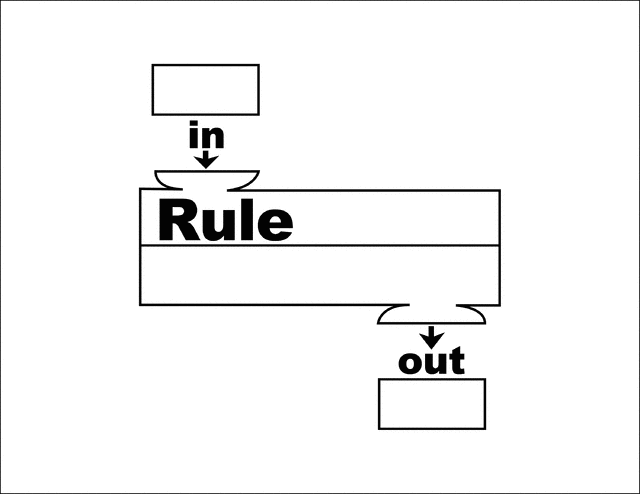
We also introduced the Function Machine in math, where students have to figure out the "rule" that is being applied to numbers.  This is very similar to the Frames and Arrows number patterns students have been doing, but it is usually displayed with a box showing numbers going in and out, and then the input and output numbers are in a table or list.  It can be a bit of an abstract concept for students and the visual organization often confuses them, so I try to simplify it by asking students how to get from the first number (input) to the second number (output). 

This week we wrote a friendly letter to our buddies in first grade at Northeast Elementary School who will be going on the field trip to the Museum of the Earth with our class on March 9.  We should be receiving letters from them soon and will communicate with our pen pals throughout the rest of the school year!

Next week we will study these wight words: 
gave, keep, house, name, had


Please make sure your child has not accidentally brought home someone else's snow pants, and be sure that your child's name is in every article of clothing that comes to school!  Also make sure your child has extra pants, socks, and underwear here at school for when snow accidentally gets clothes wet during recess.

Please note that students are dismissed at 11:00 on both Thursday, March 5 and Friday, March 6.  Conferences will take place both afternoons.  Scroll down to sign up for a conference time if you have not already done so (I will email you or send a note to confirm your requested day/time).